NOVAI · CONCEPT PAPER
The Cognitive Tourism Thesis
How Intelligent Destinations Grow Tourism Value While Protecting the Natural, Cultural and Social Systems They Depend On
Cognitive tourism is not a strategy of restraint. It is a practical model for growing a destination — more visitors over time, longer stays, deeper engagement, richer MICE content — while keeping the instantaneous pressure on every fragile asset within its limits. It grows what does not damage and caps only what does. This paper sets out the concept, the mechanism, and the metrics.
A NOVAI Thought-Leadership Paper
Author: Steven Seet · Founder & CEO, NOVAI
NOVAI Pte Ltd · Singapore · stevenseet@ewhiz.ai
Version 1.0 · 2026
Contents
Executive Summary
1. The Problem: Tourism Consumes Its Own Capital
2. From Smart to Cognitive: A Falsifiable Distinction
3. The Reframe: Separate Pressure from Value
4. The Three Growth Levers
5. The Model Across Four Ecosystem Archetypes
6. Prerequisites: The Hard and Soft Infrastructure
7. The Cognitive Tourism Stack
8. Building the Ecosystem
9. How to Achieve It: A Phased Roadmap
10. Alignment with the SDGs and the New Urban Agenda
11. Governance: Holding the Intelligence Accountable to Limits
12. What Success Looks Like
13. Conclusion
Notes on Sources and Method
Executive Summary
Tourism is one of the largest economic forces on the planet, and one of the most self-undermining. The assets that draw visitors — coral reefs, old-growth forest, living estuaries, intact cultural quarters — are precisely the assets that degrade under the volume that tourism economics reward. Faced with this, the sustainability movement has too often offered only one answer: do less. Cap arrivals, accept lower revenue, treat protection as a cost.
This paper argues that the trade-off is false — an artefact of how destinations are run, not a law of nature. The reason it persists is that the volume model conflates two things that should be measured separately: the instantaneous pressure on a fragile asset at a given moment, which must stay within hard limits, and the total economic value a destination generates, which can grow substantially. Cognitive tourism is the practice of separating the two — and growing the second while holding the first.
The proposition: cognitive tourism grows tourism value — more visitors across the year, longer stays, deeper engagement, richer MICE content — while keeping the load on every fragile asset within its carrying capacity. It grows what does not damage, and caps only what does.
The mechanism is a cognitive layer — infrastructure that does not merely sense and report (as “smart” systems do) but anticipates and adapts. It works three growth levers at once, each of which raises value without raising pressure on any single asset:
Spread the load. Distribute visitors across sites and across time, so total throughput rises while the peak load on any one reef, trail or village falls.
Extend the stay. Use personalisation to convert short, shallow visits into longer, higher-yield ones — more nights, more dispersed activity, more local spend per arrival.
Deepen MICE. Extend the value of every business event before, around and after the event itself — turning a fly-in/fly-out meeting into a multi-touch, multi-day relationship with the destination.
The paper sets out the structural problem, defines the smart-to-cognitive distinction, presents the model across four ecosystem archetypes — marine and coastal reef, forest, riverine and estuarine, and rural cultural-heritage systems — and proposes a governance architecture in which the intelligence layer is accountable to ecological and community limits even as it drives growth. It closes with the metrics that prove the model: rising value alongside a stable or recovering asset base.
1. The Problem: Tourism Consumes Its Own Capital
Every destination runs on a stock of capital it did not create and cannot easily rebuild: the reef, the canopy, the wetland, the heritage townscape, the social fabric of the communities who host. Conventional tourism treats this stock as a free and infinite input. It is neither.
1.1 The volume reflex
The economics of mass tourism reward throughput. More arrivals, more bednights, more footfall: each is a revenue line, and each is measured and optimised. The incentive structure points in one direction — up and to the right — while the asset base has hard, finite limits. A coral reef has a daily diver threshold beyond which physical contact and sediment disturbance outpace recovery. A canopy trail has a footfall rate beyond which root systems and wildlife behaviour are permanently altered. A heritage quarter has a resident-to-visitor ratio beyond which the living culture that visitors came to experience hollows into performance.
1.2 Why “smart” is not enough
The sector’s dominant response has been instrumentation. Sensors count divers, cameras measure crowd density, apps push real-time advisories. This is valuable, but it is diagnostic, not regulatory. A dashboard that turns red when a site is over capacity is reporting a breach that has already happened. The visitor is already in the water; the delegate is already on the trail; the tour bus has already arrived in the village. Smart systems describe the problem in higher resolution. They do not resolve it.
Smart senses and reports. Cognitive anticipates and adapts. The difference is the difference between a thermometer and a thermostat — between knowing the room is too hot and a system that keeps it from overheating in the first place.
1.3 The contradiction stated plainly
Stack these together and the defining problem of sustainable tourism appears: a high-value flow of people moving across fragile, slow-regenerating, often dispersed assets, under an economic model that rewards exactly the volume those assets cannot survive. Conservation and commerce are placed in direct opposition. The standard resolution — restrict access, accept lower revenue — treats sustainability as a cost. The thesis of this paper is that the opposition is an artefact of the volume model, and that a cognitive, yield-based model removes it.
2. From Smart to Cognitive: A Falsifiable Distinction
The word “cognitive” must earn its place, or it becomes another marketing gloss on “smart.” We hold it to a strict, testable definition across three levels of capability.
| Level | What it does | Destination example |
|---|---|---|
| Traditional | Exists and informs | A printed trail map; a fixed daily ticket quota set once a year |
| Smart | Senses and reports current state | A sensor shows the reef is at capacity right now; an app flags the trail as crowded |
| Cognitive | Anticipates demand and adapts allocation within hard limits | Forecasts reef demand from booking and weather data, then prices and routes access — offering a diver a quieter window or an alternative site before the threshold is reached |
Two properties follow from the cognitive level, and both are essential to the argument.
Capacity becomes an enforced instrument, not a printed sign. Live ecological and social telemetry adjusts per-site limits dynamically — before a threshold is breached, not after. The cap is active.
Friction is removed on a pull basis. The system responds to what a visitor chooses and requests rather than acting on them unbidden. It is an intelligence the visitor draws on, not one that surveils. This distinction is what keeps the experience premium rather than intrusive — and it is what makes the data architecture defensible.
This second property carries a governance corollary. A system that reduces friction is, mechanically, a system that holds data about people’s movements and preferences. For that to be acceptable — especially where high-value or high-profile visitors are involved — personalisation must rest on opt-in, edge-processed, anonymised-by-default and data-sovereign foundations. “Low-friction and privacy-secure” is not a tension to be managed; for the premium visitor it is itself a feature.
3. The Reframe: Separate Pressure from Value
The resolution is not to do less. It is to stop measuring the wrong thing. The volume model treats a single number — arrivals — as both the measure of success and the source of harm. But those are two different variables, and a destination’s whole strategic problem changes once they are separated:
Instantaneous pressure — how many people are physically on a given reef, trail, waterway or in a given village at a given moment. This has a hard ecological or social limit. It must be capped, asset by asset, and the cap must be actively enforced.
Total value — the economic and experiential worth a destination generates across all its sites, all its visitors, and the whole calendar. This has no fixed ceiling. It can grow — through dispersal, longer stays, deeper engagement, and richer content.
The volume model fails because it can only grow value by growing pressure: the only lever it knows is “more arrivals,” which drives both at once until the asset breaks. A cognitive destination breaks that coupling. It holds instantaneous pressure flat — or even reduces it — while growing total value through levers that volume-thinking cannot see.
The core move: grow the value that does no harm; cap only the pressure that does. Preservation and growth stop being opposites and become two dials on the same instrument.
This is why cognitive tourism is a growth concept, not a rationing one. The destination that adopts it expects to earn more next year than this year — from more visitors across the calendar, staying longer and engaging more deeply — even as the load on its most fragile assets holds steady or falls. The next section sets out the three levers that make this possible.
4. The Three Growth Levers
Cognitive tourism grows total value through three levers. None of them works by increasing the number of people on a fragile asset at any one time; each works by growing the dimensions of value that volume-thinking ignores. Together they let a destination grow while it protects.
4.1 Spread the load — across space and time
The single most wasteful feature of conventional tourism is concentration: everyone wants the flagship site, at the same hours, in the same season. The flagship is loved to death while comparable sites sit idle and shoulder seasons run empty. A cognitive layer anticipates demand and actively redistributes it — steering visitors toward resilient alternatives, pricing and scheduling to flatten peaks, and filling troughs that the asset can easily absorb.
The result is counter-intuitive but rigorous: total throughput across the destination can rise substantially while the peak load on any single asset falls. More visitors, less damage — because the visitors are spread across a portfolio of sites and across the whole calendar rather than crushed onto one site in one season.
4.2 Extend the stay — through personalisation
A visitor who comes for one headline attraction and leaves the next morning extracts little value and leaves little behind. The same visitor, offered a personalised, low-friction path to the things they would actually enjoy — a quieter site nearby, a cultural experience matched to their interests, a logistics chain that simply works — stays longer, spends more, and disperses across a wider footprint.
Personalisation is the mechanism, and it must be the pull-based, opt-in kind described in Section 2: an intelligence the visitor draws on, not one that pushes at them. Done well, it converts a one-night arrival into a multi-day stay. Length of stay is the highest-leverage growth variable a destination has, because each additional night adds accommodation, food, culture and guided activity revenue without adding a single new arrival to a fragile asset’s peak load.
4.3 Deepen MICE — beyond the event itself
Business events (Meetings, Incentives, Conferences and Exhibitions) are among the highest-yield visitors a destination can host — but conventionally their value is trapped inside the event’s few days. The delegate flies in, attends, and flies out. The destination captures a fraction of the value in the room and almost none of the value around it.
Cognitive tourism extends the engagement across three windows:
Before the event. Personalised pre-arrival planning, curated extension options, and matched-interest experiences convert intent into booked, extended stays before the delegate ever lands.
Around the event. Intelligent orchestration fills the gaps in a delegate’s schedule with low-friction, high-value experiences — a half-day nearby, an evening cultural programme — without disrupting the event itself.
After the event. Post-event extensions, follow-on content, and a continuing relationship turn a one-off attendance into repeat engagement and advocacy — and a reason to return.
The effect is to multiply the value of every business event without enlarging it. The event becomes the anchor of a longer, deeper relationship with the destination, not a self-contained transaction — and because the surrounding activity is dispersed and personalised, it grows value while spreading rather than concentrating load.
Three levers, one principle: spread the load, extend the stay, deepen the engagement. Each grows value along a dimension that does not increase instantaneous pressure on any fragile asset — which is precisely how a destination grows and preserves at the same time.
5. The Model Across Four Ecosystem Archetypes
The cognitive model is general, but it is not generic: each ecosystem type has its own carrying-capacity logic, its own binding constraint, and its own failure mode. The following four archetypes show how the same thesis instantiates differently across the systems a sustainable destination is most often built upon.
5.1 The Marine and Coastal Reef System
Binding constraint: physical contact and water quality. Coral is slow-growing and intolerant of sediment, sunscreen chemistry, anchor damage, and direct touch. Reef carrying capacity is measured in divers and snorkellers per site per day, and recovery from overuse is measured in years or decades, not seasons.
Cognitive response: the system forecasts demand from dive-operator bookings, cruise schedules, tides and weather, then allocates dive slots dynamically across a portfolio of sites — steering pressure away from stressed reefs toward resilient ones, and pricing peak windows to flatten surges. Live water-quality and bleaching telemetry can close a site automatically before damage compounds. The visitor experiences this as a concierge that offers the best available window and the healthiest site, not as a denial.
Failure mode it prevents: the “flagship reef” loved to death while nearby resilient sites sit unused.
Growth it unlocks: a multi-site dive portfolio sells more dive-days in total than the single flagship ever could — at a higher price for the quieter, healthier experience — while peak load on any one reef falls.
5.2 The Forest System
Binding constraint: footfall, edge effects, and wildlife disturbance. Canopy walks, primate sanctuaries and old-growth trails have low, site-specific thresholds beyond which root compaction, trail widening, and behavioural disruption to wildlife become irreversible. Disturbance is cumulative and often invisible until it is advanced.
Cognitive response: acoustic and movement sensing monitors wildlife presence and stress in real time; the system meters trail entry, staggers group departures, and reroutes around active nesting or feeding zones. Demand anticipated from the broader visitor calendar lets the system smooth load across the day and the week rather than absorbing it in damaging peaks.
Failure mode it prevents: a trail that reports “within capacity” on a headcount while the wildlife that justified the trail has already moved away.
Growth it unlocks: staggered, timed access plus premium dawn and dusk windows raises total daily visitors and per-visit yield, while smoothing the peaks that drive wildlife away.
5.3 The Riverine and Estuarine System
Binding constraint: water quality, tidal access windows, and mangrove fragility. Estuaries are nurseries; mangroves are both carbon sinks and storm defences. Access is governed by tides, and the system’s tolerance for boat traffic, wake, and nutrient load is narrow and easily exceeded.
Cognitive response: the system aligns access to tidal windows and water-quality readings, caps simultaneous vessel movements, and matches visitor demand to the hours when the system can bear it — converting a hard physical constraint into a scheduled, premium, naturally scarce experience. Predictive water-quality modelling allows pre-emptive closure rather than reactive cleanup.
Failure mode it prevents: nutrient and wake damage accumulating across a season because each individual trip looked harmless in isolation.
Growth it unlocks: tide-aligned, scheduled access turns a hard physical constraint into a premium, naturally exclusive experience that can run reliably across more of the year.
5.4 The Rural Cultural-Heritage System
Binding constraint: community consent and authenticity. The fragile asset here is social, not ecological: the time, privacy and goodwill of host communities, and the integrity of living culture. Its failure mode is resident burnout and the conversion of authentic culture into staged performance — at which point the asset is gone even though the buildings remain.
Cognitive response: the system treats resident-burnout indicators as a first-class limit alongside ecological ones — metering visitor numbers against community-set thresholds, routing flow to distribute both benefit and burden, and giving communities a direct, auditable hand on the cap. Yield-based economics mean fewer, higher-value visitors and more revenue retained locally, which aligns the host community’s interest with conservation of its own culture.
Failure mode it prevents: a heritage village that maximises day-trip volume until the residents who were the attraction no longer wish to participate.
Growth it unlocks: dispersing flow across more communities and converting day-trips into overnight, deeper cultural stays grows total visitor value and local income while easing pressure on any single village.
Across all four, the pattern is identical: a hard, often invisible limit on instantaneous pressure; a volume model that grows value only by breaching that limit; and a cognitive layer that holds the limit while growing value along the dimensions volume-thinking cannot see — dispersal, dwell time, depth of engagement. This is the NOVAI thesis applied to the relationship between humanity and nature: making the load a place can bear measurable and enforceable, so that a destination can grow precisely because its fragile systems are protected.
6. Prerequisites: The Hard and Soft Infrastructure
Cognitive tourism is not an app that can be switched on. It is a capability that rests on two kinds of infrastructure — the physical and digital systems that sense and connect (the hard layer), and the institutional, legal and human systems that govern and operate it (the soft layer). Most destinations over-invest in the first and neglect the second; in practice the soft layer is where cognitive programmes succeed or fail.
6.1 Hard infrastructure
The physical and digital substrate that lets a destination sense state and act on it:
Distributed sensing. Ecological and movement telemetry at the points that matter — reef and water-quality sensors, trail footfall and acoustic monitors, estuary and weather stations, crowd-density counting at venues and sites.
Edge computing. Processing close to where data is gathered, so that personal data can be anonymised at the point of capture and decisions can be made with low latency, without streaming raw video or location to a central server.
Connectivity. Dense, reliable networks across both the urban core and the dispersed natural sites — the hardest and most-neglected requirement, because fragile assets are usually remote.
A unified data backbone. Somewhere for the signals to converge and be related to one another — the layer that lets a booking, a tide reading, and a trail count be reasoned about together.
Access and flow control points. The physical means to enact a decision — timed-entry gates, booking and ticketing systems, shuttle and transfer scheduling — without which the intelligence can only advise, not act.
6.2 Soft infrastructure
The institutional and human systems that make the hard layer legitimate and effective:
Governance and a carrying-capacity mandate. A body empowered to set and enforce limits, structurally separated from revenue (developed in Section 11).
Data-sharing agreements. The legal and commercial framework under which airlines, hotels, operators and venues contribute and draw data — the single most important soft-infrastructure element, and the one that takes longest to build.
Data sovereignty and privacy framework. Opt-in, anonymised-by-default rules that make participation safe for visitors and defensible for operators.
Skills and operating capability. People who can run an adaptive system — data stewards, destination analysts, and trained front-line staff — plus the local enterprise and hospitality training that turns visitor flow into resident livelihoods.
Community consent mechanisms. Especially for cultural-heritage systems, a standing means for host communities to set and adjust their own limits.
Aligned commercial incentives. Pricing, fee and revenue-share arrangements that reward dispersal, longer stays and stewardship rather than raw volume — so the ecosystem wants what the system optimises for.
The asymmetry to remember: hard infrastructure is bought; soft infrastructure is built. Sensors arrive in weeks; data-sharing trust, governance legitimacy and community consent take years — and without them the sensors are just dashboards.
7. The Cognitive Tourism Stack
The capability can be understood as a stack of five layers. Each rests on the one below; value is created at the top, but integrity depends on the bottom. The visitor and most operators only ever see the top layer — the rest works in the background.
| Layer | What it does | Why it matters |
|---|---|---|
| 5 · Experience | The pull-based, opt-in concierge the visitor and operator interact with — planning, booking, in-trip guidance. | Where value is delivered and captured. The only layer most people see. |
| 4 · Orchestration | Allocates access, prices windows, routes flow, matches demand to capacity — the decision layer. | Turns prediction into action within hard limits. This is the “cognitive” act. |
| 3 · Intelligence | Forecasting and modelling — demand prediction, carrying-capacity models, scenario simulation. | Lets the system anticipate rather than merely report. The shift from smart to cognitive. |
| 2 · Data backbone | Unifies and relates signals from sensors, operators and bookings; enforces privacy and sovereignty rules. | Without integration, signals stay siloed and the system stays blind. |
| 1 · Sensing | Ecological, movement and operational telemetry, processed at the edge. | The ground truth. Everything above is only as good as what is sensed here. |
Two design principles govern the whole stack. First, human-in-the-loop: the orchestration layer advises and acts within bounds, but people retain visibility and override. Second, pull, not push: the experience layer responds to what visitors and operators request, rather than acting on them unbidden — which is what keeps the system premium, trusted, and legally defensible.
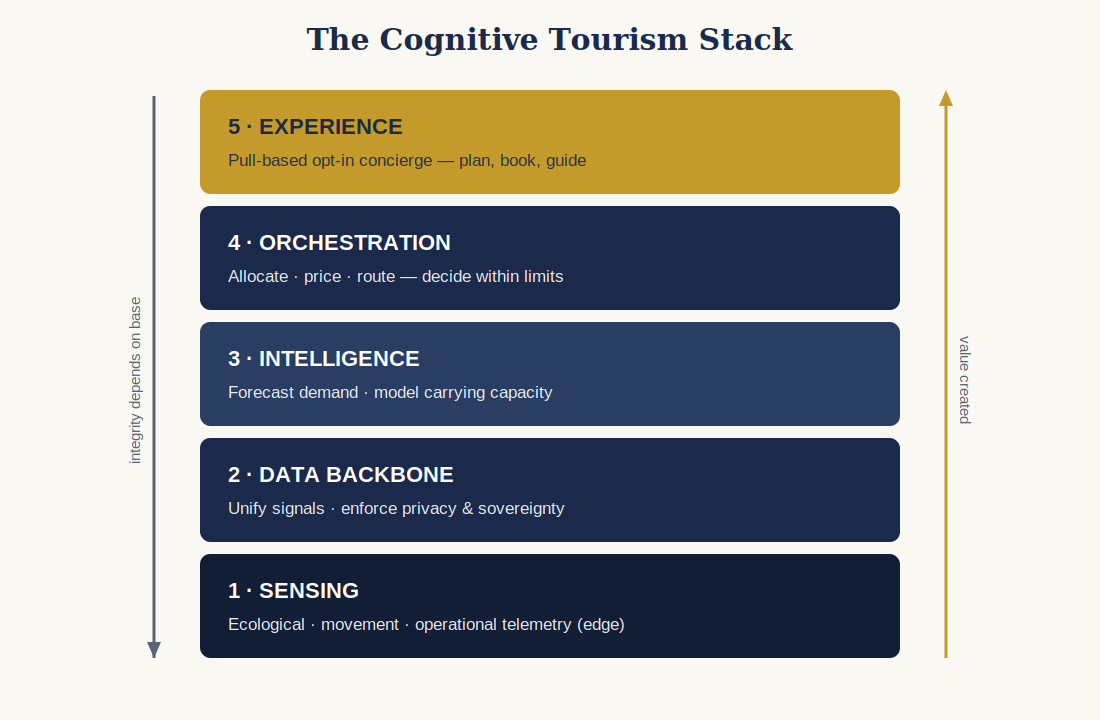
Figure 1. The five-layer Cognitive Tourism Stack. Value is created at the top; integrity depends on the base.
8. Building the Ecosystem
A cognitive destination is only as capable as the ecosystem feeding and acting on it. Airlines, hotels, transport companies, restaurants, tour operators and venues are not vendors to the system — they are nodes within it. The organising principle is a two-way exchange: each player contributes data and capacity to the system, and in return receives intelligence that makes its own business more profitable. Participation must be designed so that the self-interested choice and the system-optimal choice are the same choice.
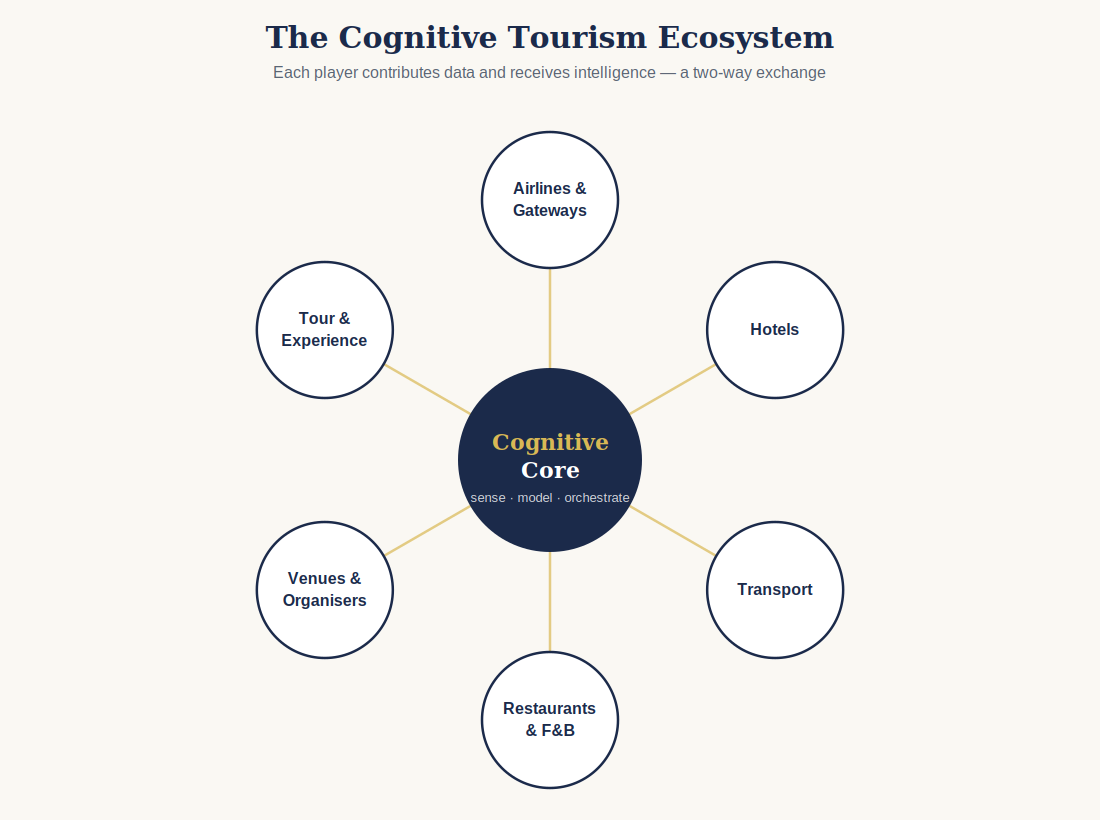
Figure 2. The ecosystem as a two-way exchange. Each player feeds the cognitive core and draws intelligence back.
8.1 How each player joins the system
Airlines and gateways. They contribute forward booking and arrival data — the earliest signal of demand the system has. They receive demand-shaping intelligence: which routes and dates to promote to fill troughs, and advance visibility that lets them sell connected, extended itineraries rather than point-to-point seats.
Hotels and accommodation. They contribute occupancy, length-of-stay and booking-pace data. They receive yield and dispersal intelligence — guidance on filling shoulder seasons, packaging multi-night stays, and matching guests to experiences that extend the stay, which is the hotel’s highest-value outcome too.
Transport and transfer companies. They contribute real-time movement and capacity data and act as the physical flow-control layer. They receive optimised scheduling and routing — shuttles aligned to event schedules and tides, demand anticipated rather than chased, fewer empty runs.
Restaurants and F&B. They contribute footfall and demand-timing data. They receive flow forecasts that let them staff and stock to predicted demand, and placement in the visitor’s personalised itinerary — dispersing diners across venues and hours rather than concentrating them.
Venues and event organisers. They contribute event calendars and attendance profiles — the anchor demand signal. They receive the means to extend MICE value before, around and after the event, converting attendees into longer-staying, higher-yield visitors and raising the venue’s own utilisation.
Tour operators and experience providers. They contribute capacity, booking and on-site data, and execute access at the fragile sites. They receive dynamic allocation that steers demand toward resilient sites and premium windows — protecting the assets their business depends on while raising their yield per guest.
8.2 The exchange at a glance
| Player | Contributes to the system | Receives from the system |
|---|---|---|
| Airlines / gateways | Forward booking and arrival data | Demand-shaping; extended-itinerary sales |
| Hotels | Occupancy, length-of-stay, booking pace | Yield and dispersal; longer stays |
| Transport | Real-time movement and capacity | Optimised, anticipatory scheduling |
| Restaurants / F&B | Footfall and demand timing | Demand forecasts; itinerary placement |
| Venues / organisers | Event calendars, attendance profiles | Extended MICE value; higher utilisation |
| Tour / experience operators | Capacity, bookings, on-site data | Dynamic allocation; protected assets, higher yield |
The design rule for the ecosystem: no player should have to choose between its own profit and the health of the destination. The exchange is built so that contributing data and following the system’s guidance is also the most profitable thing each player can do.
9. How to Achieve It: A Phased Roadmap
Cognitive tourism is built in stages, not commissioned in one. Attempting the full adaptive system on day one fails on the soft infrastructure every time. The realistic path is crawl, walk, run.
9.1 Crawl — sense and govern
Establish the carrying-capacity authority and its mandate; agree provisional limits per asset.
Deploy sensing at the most pressured assets; stand up the data backbone and privacy framework.
Sign first data-sharing agreements with a few willing anchor operators.
Outcome: the destination can see its true state and has the legitimacy to act. This is a smart destination — necessary, but not yet cognitive.
9.2 Walk — predict and personalise
Add the intelligence layer: demand forecasting and carrying-capacity models.
Launch the pull-based concierge for visitors; begin dispersal and length-of-stay personalisation.
Onboard the wider ecosystem (hotels, transport, F&B, venues) onto the exchange.
Outcome: the destination begins to anticipate and shape demand, and the growth levers start to work.
9.3 Run — orchestrate and optimise
Full orchestration: dynamic allocation, pricing and routing within enforced limits.
Deepen MICE across before/around/after; extend personalisation across the whole journey.
Operate on the dual scorecard — value growing while asset load holds or improves.
Outcome: a genuinely cognitive destination, growing and preserving simultaneously, with a data moat that compounds each season.
The sequencing discipline: build governance and data trust before intelligence, and intelligence before orchestration. A destination that buys orchestration software before establishing its limits and its data agreements has built a fast car with no brakes.
10. Alignment with the SDGs and the New Urban Agenda
Cognitive tourism is not only a commercial proposition; it is a practical instrument for the global sustainability agenda. The United Nations, through UN-Habitat, frames sustainable urban development around the 2030 Agenda’s 17 Sustainable Development Goals and the New Urban Agenda — the framework that identifies how sustainable urbanisation is actually achieved, through governance, planning, finance and infrastructure. UN-Habitat organises the SDGs around three transformative commitments; cognitive tourism advances all three at once.
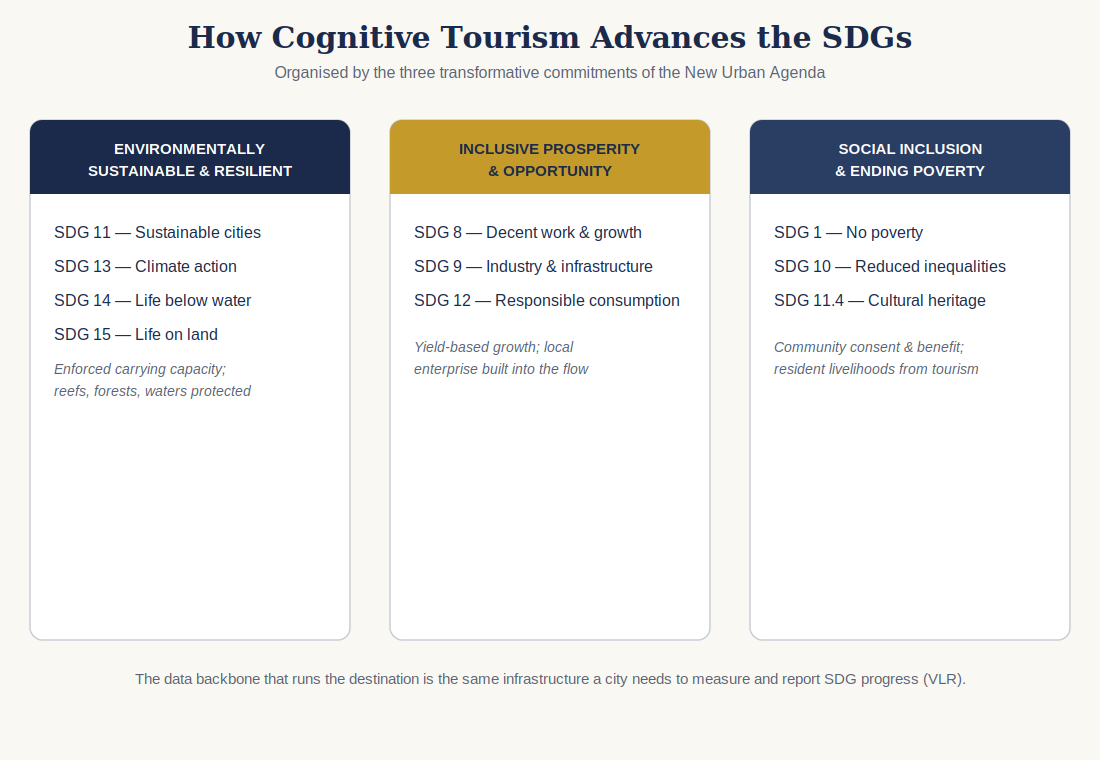
Figure 3. Cognitive tourism mapped to the SDGs, grouped by the three transformative commitments of the New Urban Agenda.
10.1 The three commitments, served together
Environmentally sustainable and resilient development. This is cognitive tourism’s home ground. By making carrying capacity a live, enforced limit, it directly serves SDG 11 (sustainable cities and communities), SDG 13 (climate action), SDG 14 (life below water) and SDG 15 (life on land) — protecting reefs, forests, waters and habitats as a condition of doing business rather than an afterthought to it.
Inclusive prosperity and opportunity. The yield-based growth model — more value from longer, deeper, dispersed engagement rather than raw volume — supports SDG 8 (decent work and economic growth), SDG 9 (industry, innovation and infrastructure) and SDG 12 (responsible consumption and production). Because value is captured locally and across a wider footprint, prosperity is broadened rather than concentrated.
Social inclusion and ending poverty. By treating community consent and resident burnout as first-class limits, and by building local enterprise into the visitor flow, the model serves SDG 1 (no poverty), SDG 10 (reduced inequalities) and SDG 11.4 (safeguarding cultural and natural heritage). The host community is a beneficiary and a decision-maker, not a backdrop.
10.2 The measurement dividend
There is a deeper alignment, and it is the one most relevant to UN-Habitat’s method. The agenda increasingly runs on measurement — Voluntary Local Reviews, urban observatories, and city-level SDG indicator tracking — because what cannot be measured cannot be managed or financed. Cognitive tourism is, at its core, a measurement-and-action engine. The same data backbone that lets a destination sense its carrying capacity and orchestrate its flows produces, as a by-product, exactly the evidence a city needs to report SDG progress.
The institutional fit: a cognitive destination generates SDG evidence as a by-product of running itself. Sustainability stops being a compliance report compiled after the fact and becomes a live, operational property of the city — measured continuously, and acted on in real time.
This reframes the relationship between tourism and the sustainability agenda. In the volume model, tourism is something the SDGs must be defended against. In the cognitive model, a well-run destination becomes one of the most powerful accelerators of the New Urban Agenda a city has — generating prosperity, funding conservation, sustaining culture, and measuring all three as it goes.
11. Governance: Holding the Intelligence Accountable to Limits
A cognitive destination makes autonomous adjustments — closing a site, repricing a window, rerouting a group. That power requires a governance architecture, or it will quietly be bent back toward throughput by commercial pressure. Three safeguards are non-negotiable.
A carrying-capacity authority insulated from commercial override. The body that sets and enforces ecological and community limits must be structurally separate from the body that earns revenue from access. The cap cannot be a number that sales can negotiate.
Explainability and human-in-the-loop control. When the system reroutes flow or closes a site, decision-makers must have auditable visibility into why, and the ability to override in a crisis. The intelligence advises and enforces within bounds; it does not rule unaccountably.
Data sovereignty and opt-in by default. Personalisation rests on edge-processed, anonymised-by-default, opt-in data. The visitor draws on the intelligence; the intelligence does not harvest the visitor. This is both an ethical floor and, for premium and high-profile visitors, a selling point.
The moat. A competitor can copy a booking app in months. Replicating years of verified, bilateral, site-specific carrying-capacity data — the longitudinal record of what each fragile system can bear and what each visitor segment actually yields — is structurally hard, and gets harder every season. The data is the durable advantage.
12. What Success Looks Like
A cognitive destination proves itself on two scorecards at once: value must grow, and asset load must hold within limits. A model that grows value by breaching limits has failed; so has one that protects limits by forgoing growth. The table contrasts what the volume model measures with what a cognitive destination measures.
| Volume model measures | Cognitive model measures (grow + preserve) |
|---|---|
| Total arrivals | Total value across the calendar — and peak load per asset, held within limits |
| Bednights at peak | Length of stay and off-peak / shoulder-season growth |
| Headline-site footfall | Portfolio spread across resilient and flagship sites |
| Event attendance | MICE value before, around and after the event |
| Occupancy | Yield per visitor and revenue per protected hectare |
| — | Ecological and community load trend (must be flat or improving) |
The defining test is the relationship between the two columns over time: value rising while asset load holds steady or falls. A destination achieving that has proven the thesis — it is growing and preserving simultaneously, which the volume model holds to be impossible.
13. Conclusion
Sustainable tourism has been framed, for decades, as a trade-off: protect the asset or profit from it, but not both. That framing is a consequence of the volume model — which can only grow value by growing pressure — not a law of nature. Cognitive tourism breaks the coupling. By making the load a place can bear a live, enforced, measurable variable, and by growing value through dispersal, longer stays and deeper engagement rather than through raw arrivals, it lets a destination grow and preserve at the same time. Protection stops being the price of sustainability and becomes the foundation of growth.
This is, at root, the same proposition NOVAI advances everywhere: that in a world where almost everything can be faked, generated, or overrun, the scarce and valuable thing is trust — and trust can be made measurable. Between people. Between partners. And between humanity and the natural and cultural systems we are, finally, running out of room to take for granted. Cognitive tourism is that principle made practical: a working model for destinations that intend to be more valuable in twenty years than they are today, with their reefs, forests, waters and living cultures more intact, not less.
When intelligence is abundant, trust is the scarce asset — and trust is what we make measurable.
Notes on Sources and Method
This paper is a conceptual and methodological argument rather than an empirical study of any single site. The carrying-capacity logic it draws on is well established in the conservation and destination-management literature — limits of acceptable change, recreational ecology, and visitor-impact management frameworks — and the smart-to-cognitive distinction follows the trajectory from instrumented “smart city” infrastructure toward adaptive, agentic urban intelligence. The sustainability mapping in Section 10 follows the United Nations 2030 Agenda (the 17 Sustainable Development Goals) and UN-Habitat’s New Urban Agenda, including its three transformative commitments and the Voluntary Local Review mechanism for city-level SDG monitoring. The four ecosystem archetypes are presented as generalised models; specific thresholds, telemetry choices, and governance instruments must be calibrated to each destination through primary ecological and community assessment.